
The following are examples of SOME of the many culturally or technologically significant arcade games that are included in VIDEOTOPIA.
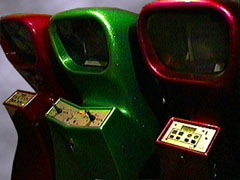
| Computer Space, Nutting Associates, 1971. Designed by Nolan Bushnell, member of the VIDEOTOPIA Advisory Panel, Computer Space was the first commercial arcade videogame. |
|
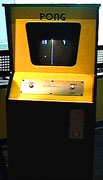
| Pong, Atari Inc., 1972. Using the profits from Computer Space, Nolan Bushnell formed Atari and tapped Al Alcorn, member of the VIDEOTOPIA Advisory Panel, to construct this first commercially successful arcade videogame. |
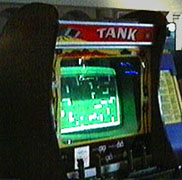
| Tank, Kee Games/Atari Inc., 1974. Tank was the first videogame to use ROM (Read Only Memory) chips to store graphic data. ROM chips allowed TANK's on-screen characters to be more detailed, rather than simple blocks like Pong, or collections of dots as in Computer Space. |
|
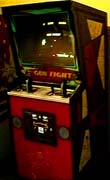
| Gunfight, Taito/Midway, 1975. A two-player game set in the old-west and the first game to utilize a microprocessor. |
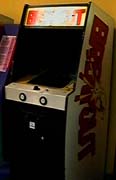
| Breakout, Atari Inc., 1976. Designed by Atari's fortieth employee Steve Jobs, aided by videogame enthusiast Steve Wozniak. The two later went on to found Apple Computer, using parts "borrowed" from Atari to build their first prototype. |
|
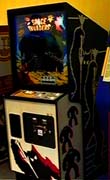
| Space Invaders, Taito/Bally/Midway, 1978. The first blockbuster videogame. Space Invaders was the first game to appear outside of arcades and bars and reach a mainstream audience in places like restaurants and ice-cream parlors. |
|
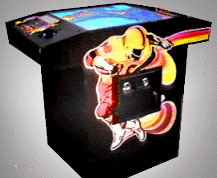
| Football, Atari Inc., 1978. The first true video sports game, Atari's Football was created by Dave Stubben from a game project called X's and O's that was begun by Steve Bristow before he started Tank. Football amazed players with its fast action and complex simulation of a team sport, and it also marked the introductions of both the Trak-Ball and scrolling displays. |
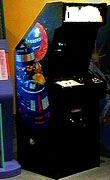
| Lunar Lander, Atari Inc., 1979. Illustrating principles of Newtonian laws, Lunar Lander was the first Atari game to incorporate vector display technology. Atari's vector display system was designed by Howard Delman. Vector graphic display technology was in part conceived for the Apollo space program in an attempt to create a system capable of simulating the moon landing. |
|
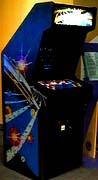
| Asteroids, Atari Inc., 1979. Designed by Ed Logg, Asteroids was a huge commercial success which established videogames as a lasting entertainment media. At the height of its popularity in 1980, a Newsweek article pointed out the fact that Asteroids' audience included large numbers of adult professionals who released workday stress playing the game during their lunch breaks. The game's sequel, Asteroids Deluxe, was released the following year. |
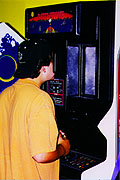
| Battlezone, Atari Inc., 1980. Featuring the first truly interactive 3-D environment, Battlezone so impressed the United States Armed Forces that they commissioned Atari to build specially modified and upgraded versions for use in tank training. The Electronics Conservancy has secured one of these modified games, and it will be displayed in VIDEOTOPIA in the near future. |
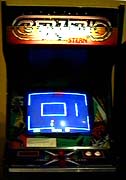
| Berzerk, Universal Research Laboratories/Stern Inc., 1980. Just passing a Berzerk machine was a new experience for most people. The machine actually spoke! Few people had experienced voice-synthesis at the time, and it made quite an impression. Because digitization was so expensive, the sentences spoken by Berzerk shared a vocabulary of only 30 words. |
|
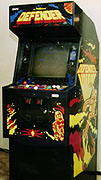
| Defender, Williams Electronics, 1980. Designed by Eugene Jarvis, member of the VIDEOTOPIA Advisory Panel, Defender was the first mega-hit by current arcade industry powerhouse Williams Electronics. It was also the first game to feature an artificial "world" in which game events could occur outside the on-screen view presented to the player. |
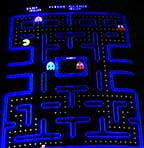
| Pac-Man, Bally/Midway, 1980. Licensed from the company Namco, Pac-Man was based on an ancient Japanese folk-tale. The game was so successful in Japan that it actually caused a Yen shortage. Pac-Man also took America by storm, appearing on the cover of Time Magazine as well as spawning a Saturday-morning cartoon and a hit song. |
|
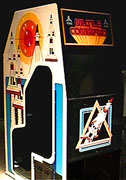
| Missile Command, Atari Inc., 1980. Designed during the 1979 presidential race, Missile Command (originally to be called "Armageddon") was a clear reflection of America's fear of nuclear conflict. One of VIDEOTOPIA's Missile Commands is the cockpit variant, one of less than 100 made. |
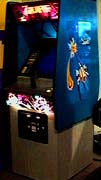
| Gorf, Bally/Midway, 1981. After importing some of the most successful "slide and shoot" games (Space Invaders, Galaxian, Galaga), Bally/Midway created Gorf by literally combining Space Invaders and Galaxian with a few other similar games of their own creation. Gorf was one of the first games to offer distinct stages of differing game play, as well as one of the earliest talking videogames. |
|
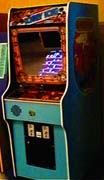
| Donkey Kong, Nintendo Ltd., 1981. Designed to salvage a huge inventory of "Radarscope" arcade games (a bland shoot-em up game that did not sell well), Donkey Kong featured brilliant game play and a whimsical storyline about a giant ape and a curious character referred to only as "Jumpman." It would not be until after the game's design and construction that Jumpman would receive the now-famous name "Mario." |
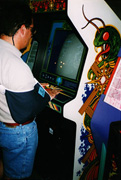
| Centipede, Atari Inc., 1981. Designed by Ed Logg and Dona Bailey, Centipede was the first arcade game from a woman designer. Colorful graphics and ingenious game play made Centipede the first game to attract more female fans than male. |
|
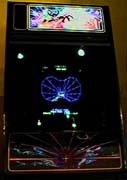
| Tempest, Atari Inc., 1981. The first Atari game to utilize a color vector display, Tempest featured surrealistic 3-D wireframe graphics. The game was inspired by a dream of the designer's and was an instant hit. Interest in Tempest has remained strong as evidenced by the recently acclaimed Tempest 2000 for the Atari's defunct 64-bit Jaguar multimedia system, the popular Sega Saturn, Sony Playstation, and personal computers. |
| Warlords, Atari Inc., 1981. A multi-player variation of Breakout, Warlords' design leads players to discover that cooperation is the only way to progress to the higher levels of the game and encourages them to develop rules and strategies of their own. The 4-player cocktail table version is also on display. |
|
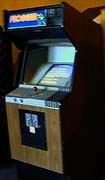
| Frogger, Konami/Sega, 1981. Frogger is a favorite of many with its attractive graphics and gameplay of navigating through moving obstacles (harkening back to Atari's 2nd title, Space Race). A well-crafted update to the game has recently been released by Hasbro. |
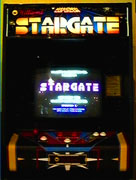
| Stargate, Williams Electronics, 1981. Designed by Eugene Jarvis and Larry DeMar, as a seperate company, this sequel to Defender was harder and more elaborate. Stargate gave names to the player's enemies... the Irata, Yllabians... the names of Williams' main competitors at the time spelled backwards! Ironically, Williams Electronics' parent company now owns those competitors. |
|
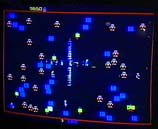
| Robotron: 2084, Williams Electronics, 1982. Designed by the same team that created Defender, Robotron: 2084 went through many changes from concept to reality. The game was originally called Robot War: 1984 and spanned many screens which would scroll in all directions. At one point, the control scheme consisted of a joystick and a trak-ball. Gameplay was ultimately confined to a single screen, and two joysticks were used for input. Original Robotron: 2084 design sketches and scripts are on display in VIDEOTOPIA's "Game Design" area. |
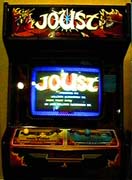
| Joust, Williams Electronics, 1982. The fun of Joust was greatly magnified by its multi-player format. Joust's structure makes for constantly changing strategies as waves where you score extra points for cooperating with another player alternate with waves that have you competing for points - or to dismount each other! Interestingly, some studies have shown that competitive games actually reduce levels of aggression, while cooperative games boost aggressiveness. Joust's ever-changing nature makes it an interesting test-bed for this theory. |
|
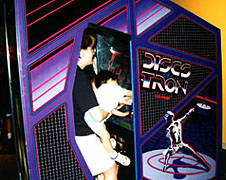
| Tron, Bally/Midway, 1982. Designed in conjunction with the Disney feature film, the game became integral to the plot of the movie and eventually influenced its final look as well. The product of a competition between game-design theories, the videogame Tron actually out-grossed its film counterpart. Its 1983 sequel Discs of Tron (pictured) was originally planned to be a part of the first game. Due to time and technological constraints, Discs of Tron was released as a separate game following the original's success. |
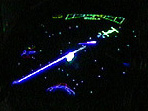
| Star Wars, Atari Inc., 1983. Designed by Mike Hally, programmed & developed by Greg Rivera, Norm Avellar, Eric Durfey, Jed Margolin, & Earl Vickers. The basic game engine for Star Wars was converted from a 2-year old space game project called Warp-Speed, which was designed to develop 3-D image capabilities. Star Wars originally used a joystick. The Flight Controller was designed by modifying the controller created for the military version of Battlezone. |
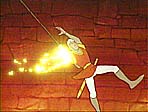
| Dragon's Lair, Starcom/Cinematronics, 1983. Created by Rick Dyer and animated by Don Bluth, Dragon's Lair was an interactive film that became the first released game to utilize laser disc technology. Dragon's Lair's visuals fascinated all who saw it, and the game achieved an immortality that no other laser disc game was able to match. |
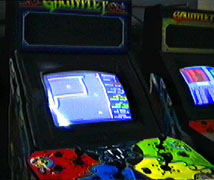
| Gauntlet, Atari Games, 1985. Designed by Ed Logg, Gauntlet was one of the first machines from Atari Games. It was a hit because of its detailed graphics and exciting theme of maze exploration. Gauntlet is a perfect illustration of the direction that future games would take - environments that multiple players could experience. |
|
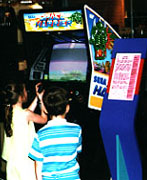
| Space Harrier, Sega, 1986. Space Harrier marked the beginnings of the transformation of established game genres (in this case the shooter) into the third dimension. Although arcade games based on polygons had been introduced, Sprite-based 3D games remained the kings of the arcade for years. Space Harrier (Sega, 1986), is a prime example of a top of the line sprite 3D game. It scaled the 32,000 color sprites fast, rotated them smoothly, and blasted the player with stereo sound. But the days of Sprite-based 3D were nearing their end. |
|
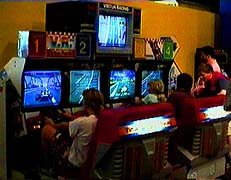
| Virtua Racing, Sega, 1992. Virtua Racing began not only a new age of fast polygon racing games, but also the dawn of the high-powered multi-player simulators. Virtua Racing combined brilliant gameplay and force-feedback steering with the most realistic graphics yet seen. In fact, many racing game enthusiasts believe Virtua Racing to still be the finest arcade racer yet made.... yet even these wonders were soon to be challenged and perhaps even surpassed. |
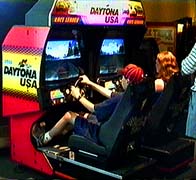
| Daytona USA, Sega, 1994. Utilizing the sweeping virtual "camera" movements, smooth animations, and multiple camera angles developed in its predecessor Virtua Racing, Daytona USA introduced the world to games that truly began to look and feel like reality. The game also perfected the art of the multi-player experience as up to 4 Daytona "twin" cabinets could be linked together to enable as many as 8 people to participate in the same game. Daytona completely redefined the racing genre with its spectacular graphics and real-world physics. |
|
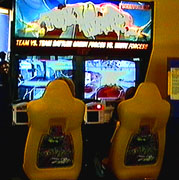
| Tokyo Wars, Namco, 1995. Tokyo Wars was released in the United States in 1997. It used twin 32-bit microprocessor systems with massive banks of storage ROMs to play what is essentially the same game as Tank! The game concepts of Tank and Tokyo Wars are nearly identical... multiple players facing off in a maze with large avenues. It is only the technology that is different. Tank was state-of-the-art in 1974... Tokyo Wars is state-of-the-art technology in 1997. The Super System 22 computing hardware that runs Tokyo Wars puts the player in the seat of a 50 ton battle tank, but when a heated game of Tank gets going, the fun and strategy is on a par with that of its descendant. |
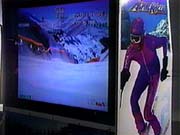
| Alpine Racer, Namco, 1996. Produced by the company that created Pac-Man, Alpine Racer used a 32-bit processor to create its stunning polygon images. Its innovative input device, combined with its 50 inch projection display immersed players in its artificial world. Seldom has a game's control mechanism been in such strong harmony to the gameplay. |
|
The info-pedestals placed next to each important game in VIDEOTOPIA offer many times more information than what is presented here!

VIDEOTOPIA and Electronics Conservancy are registered trademarks of The Electronics Conservancy, Inc. All rights reserved. All photos (c)1997, 1998 Electronics Conservancy. All videogames, characters, brand names, and trademarks are the properties of their respective owners.